
Griffintown,
A People's History:
From Settlement to Industrialization and Gentrification
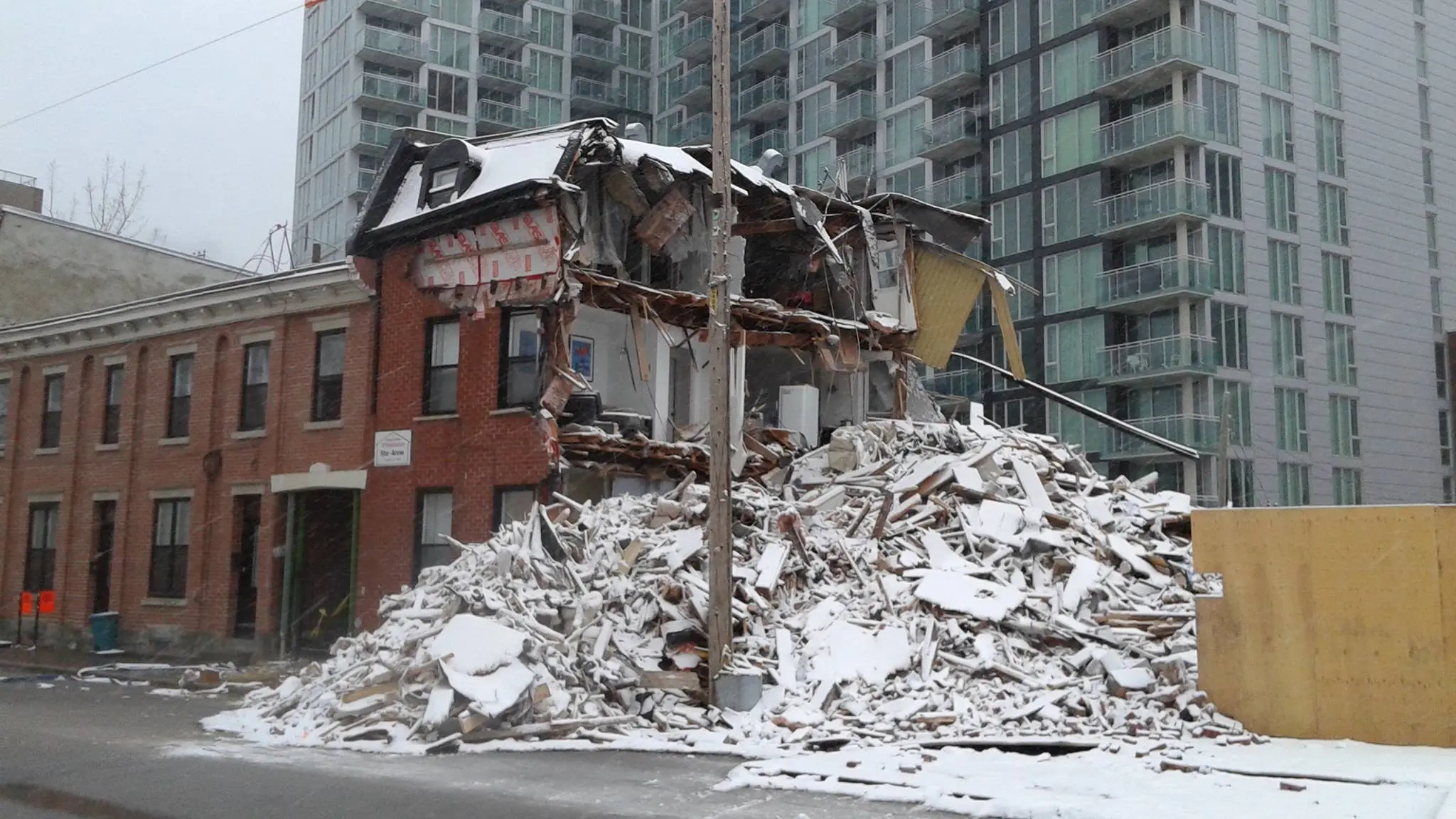
Destruction of the Housing Coop on de la Montagne in Giffintown, 2016
Logline
Through a multimedia approach using live-action, animation, archival and still photography, this series pays homage to the people and history of Montreal’s Griffintown. Dr. Matthew Barlow, a dynamic and engaging historian, guides the episodes as he explores the evolution of this post-industrial neighborhood in Montreal’s inner city and examines the impact of gentrification on its architecture and community.
Synopsis
In this five-part series, Griffintown: A People’s History – From Settlement to Industrialization and Gentrification, historian Dr. Matthew Barlow recounts the fascinating social history of Griffintown, a former industrial neighbourhood just south of downtown Montreal, that has since undergone significant gentrification. With only a handful of original civic, residential and industrial sites still standing, this once thriving community of predominantly working class Irish and French Canadians has all but disappeared. What remains of these communities endures in memory through recent books, community art projects and films, such as this project.
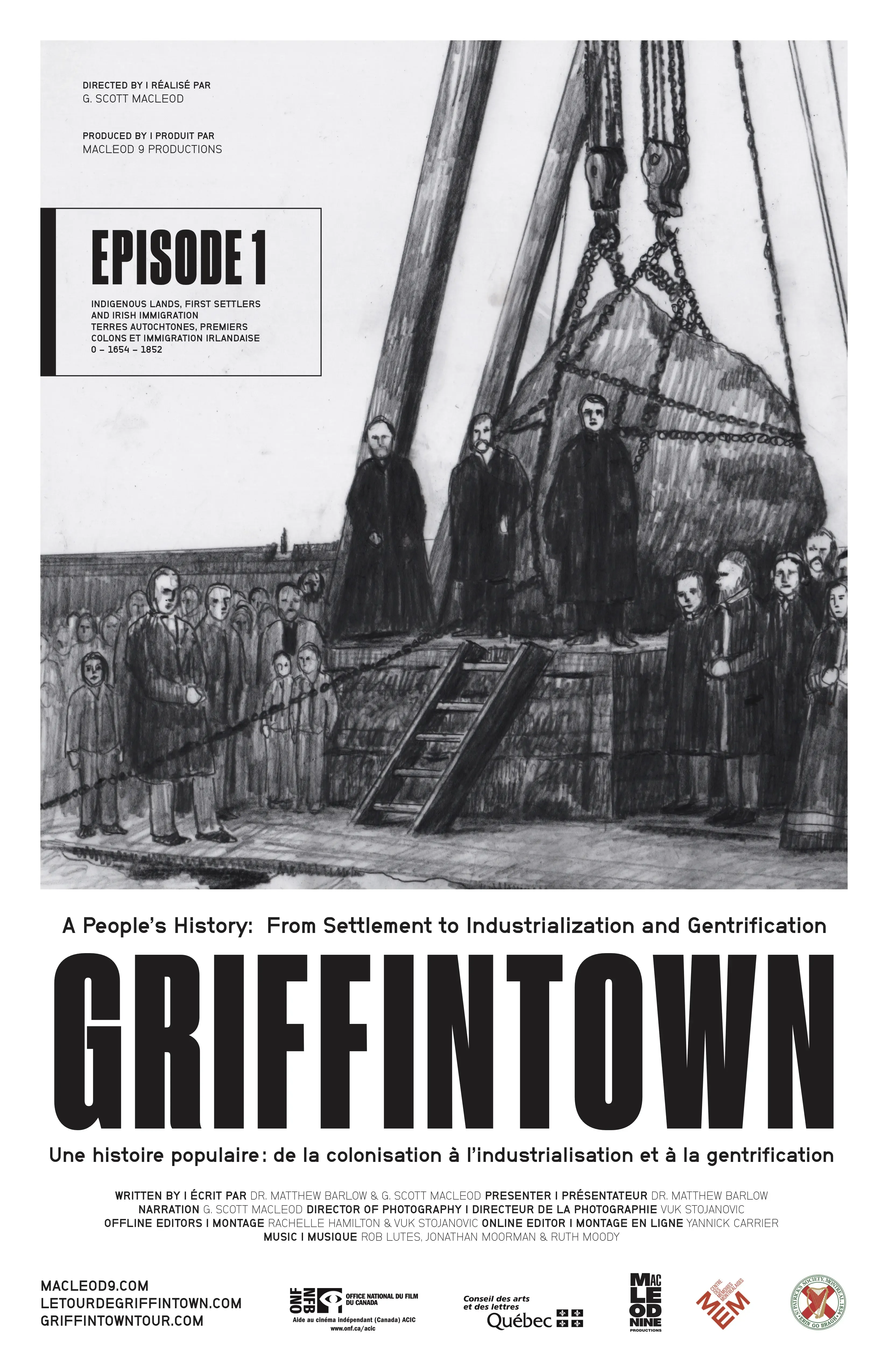
This episode provides a chronological history of Griffintown, starting with the Indigenous peoples and their encounters with early French settlers. It covers the impact of the fur trade, the fall of New France, and the rise of British colonialism. The narrative highlights the construction of the Lachine Canal in the mid-1800s, built largely by Irish immigrant laborers, marking the rise of industrial capitalism. It also details Griffintown's official establishment in 1791, when Thomas McCord’s associate, Patrick Langan, illegally sold the land to Mrs. Mary Griffin. The episode concludes with the summer of 1847-48, when 70,000 Irish immigrants arrived in Montreal and 6,000 died of typhus at Windmill Point. Their bodies were later discovered in 2019 during the construction of the Réseau Express Métropolitain (REM) track. Despite advancing technology, the legacy of these Irish immigrants should not be forgotten.

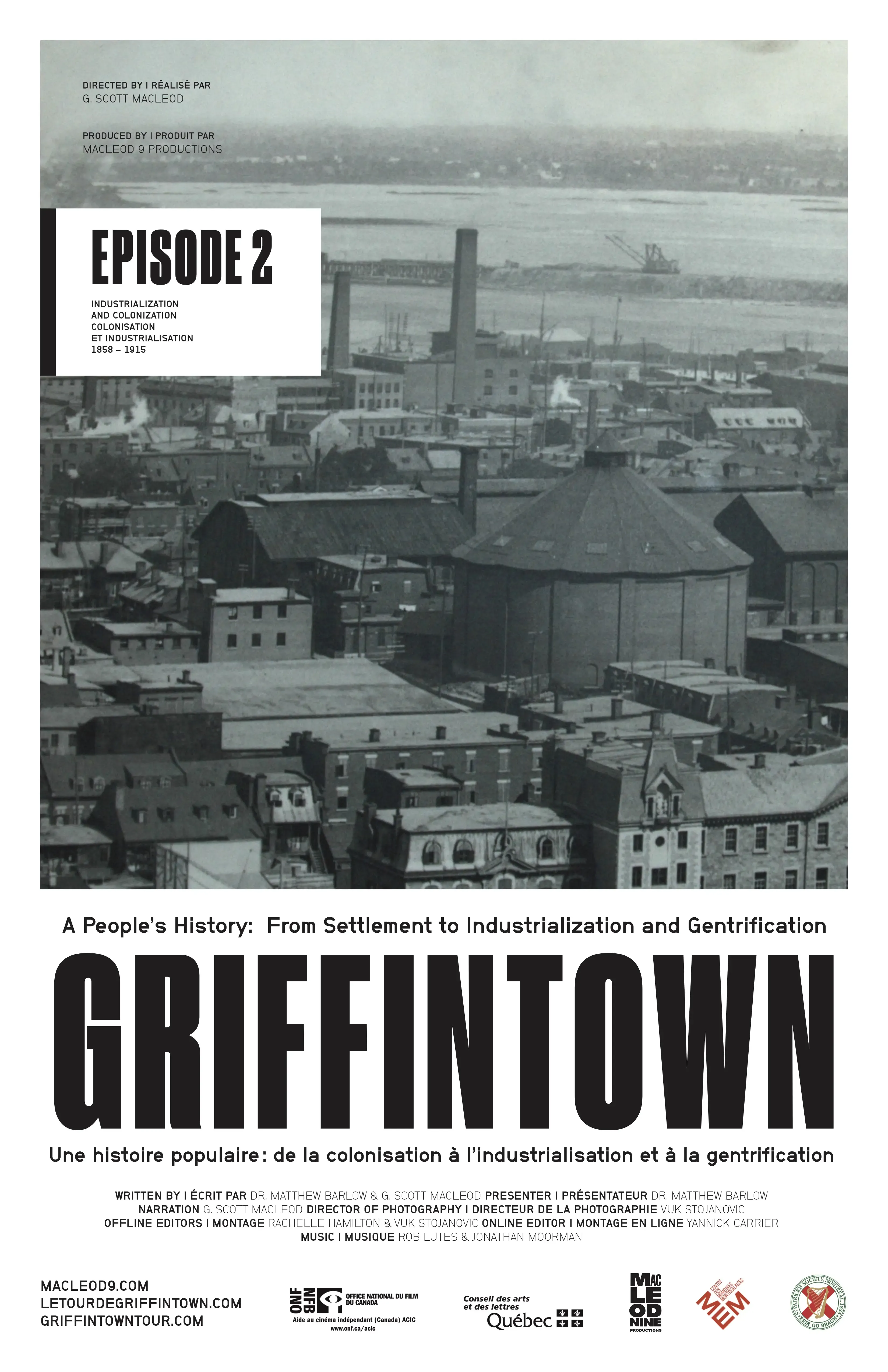
Episode 2 picks up where the previous episode left off, delving into the late 1800s and the development of the Grand Trunk Railway between 1860 and 1915, which transformed Griffintown into Canada’s industrial center. The episode also recounts notable social histories of the neighborhood from this period. One such story is from 1868, when Irish nationalist Patrick James Whelan assassinated Thomas D’Arcy McGee on Ottawa Street. This marked the first of two political assassinations in Canadian history, with Whelan's subsequent execution being the last public execution in the country. Additionally, the episode covers the famous Griffintown haunting of Mary Gallagher. Gallagher, a sex worker, was beheaded by rival Susan Kennedy on June 27, 1879. Her ghost is said to return every seven years to haunt the neighborhood on the anniversary of her death.
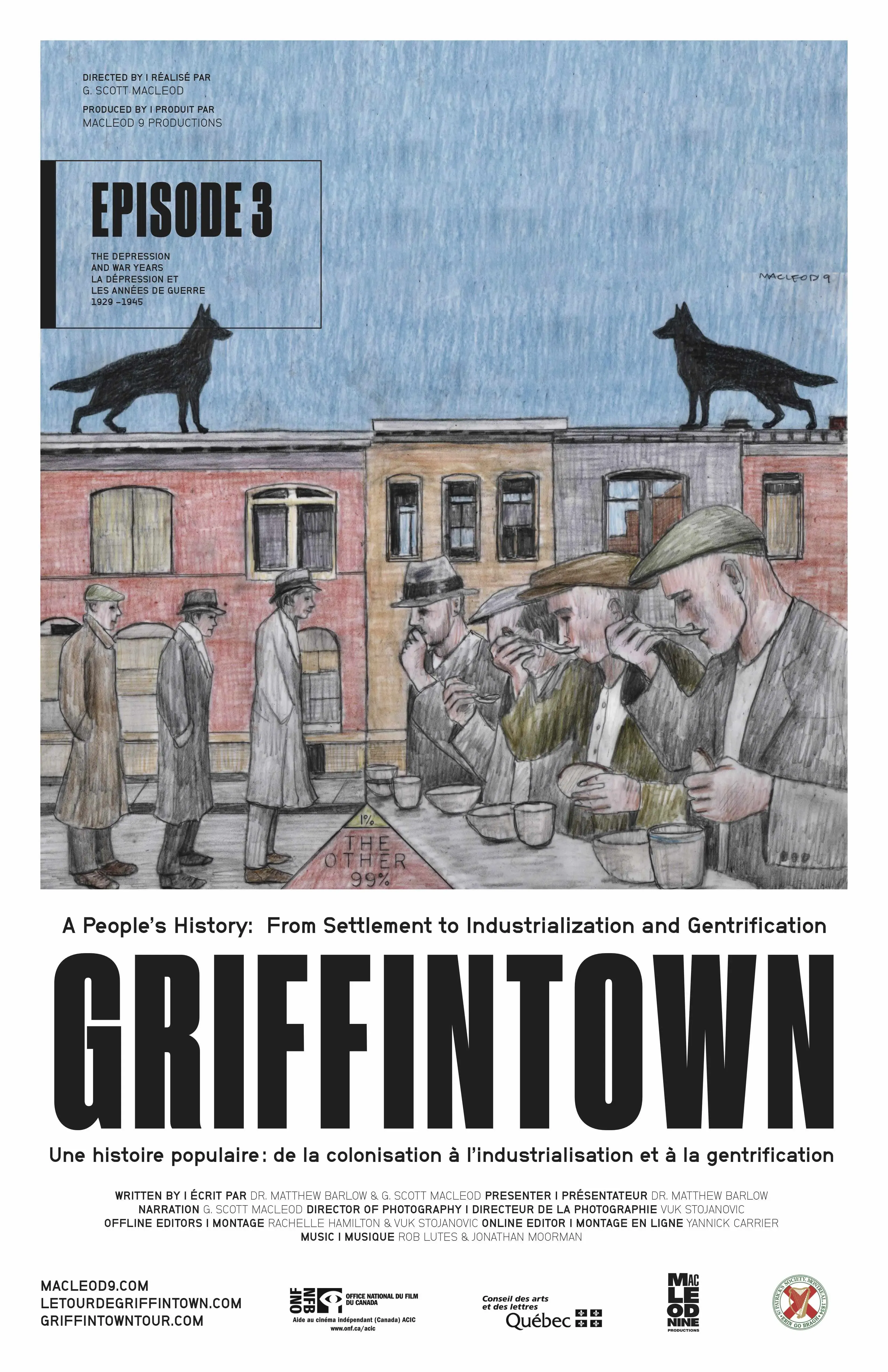
Episode 3 transitions into the 20th century, starting with the socio- political changes in Griffintown triggered by the Great Depression in 1929, and moving through key events later in the century. The episode examines shifts in homeownership, showing how local property owners became tenants as they lost their homes to banks, insurance companies, and powerful landlords. It then recounts the 1944 crash of an RAF Liberator bomber at Shannon and Ottawa streets, which resulted in fifteen fatalities. The episode also covers Griffintown’s industrial era, noting the significance of shipping waterways and railways from 1931 to 1966. Finally, it explores the role of City Councillor Frank Hanley, known as “Mr. Fix It,” and his influence on the 1959 opening of the St. Lawrence Seaway. This development rendered the Lachine Canal obsolete, leading to its closure to shipping in 1970 and marking the start of Griffintown's decline.
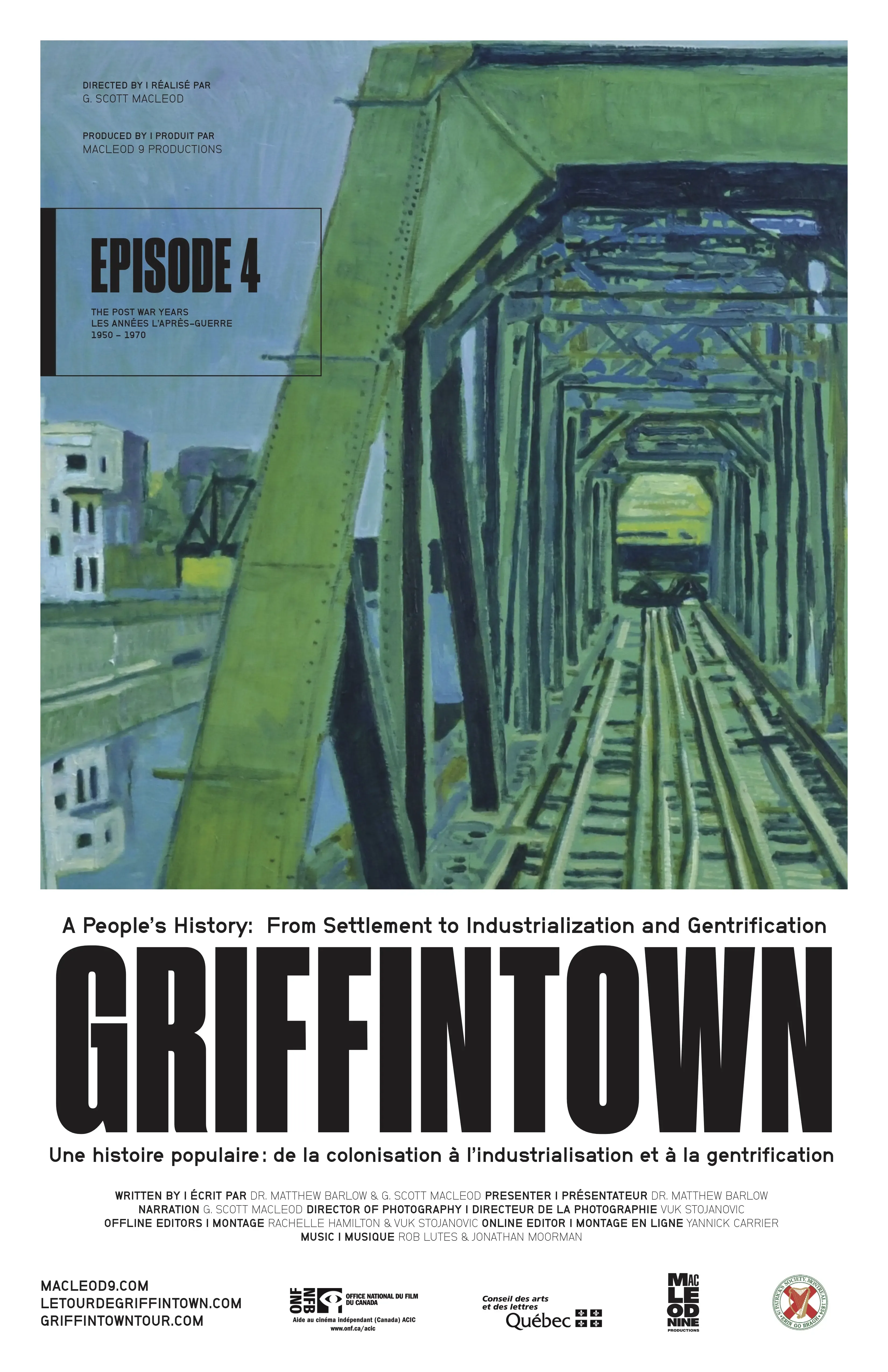
This episode highlights Griffintown's struggles during the 1950s to 1970s. In 1963, rezoning for light industrial use relieved landlords of maintaining residential properties. Urban renewal by Mayor Jean Drapeau for Expo 67, including the Bonaventure Expressway, further devastated the area, dividing the neighborhood and destroying much of the housing. This led to disrepair, demolition, and a resident exodus that began during the Great Depression. Amid the destruction, St. Ann’s Church, a center for Montreal's Irish community, was demolished, leading to the collapse of the Irish community in 1970.
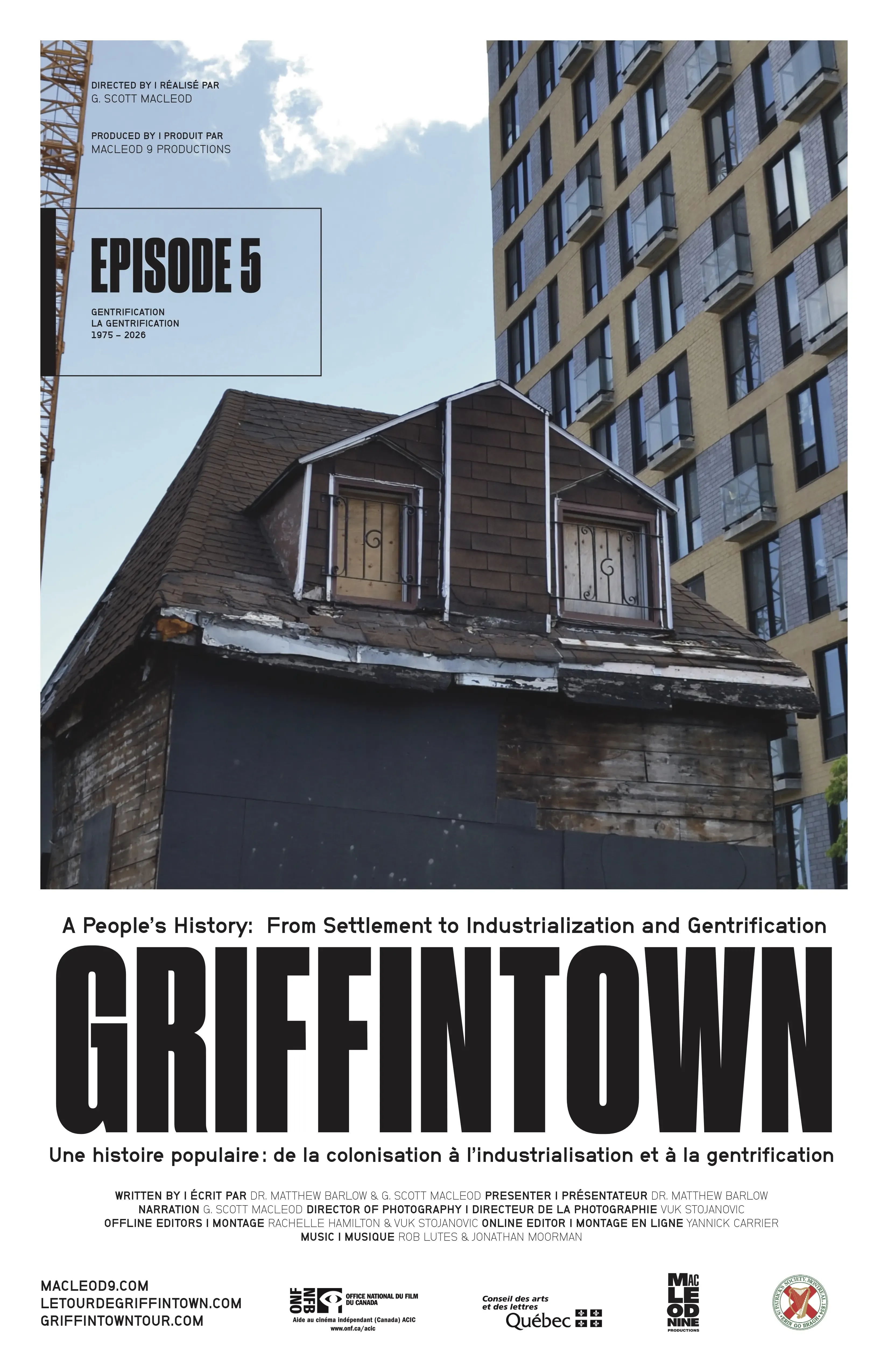
This episode is topical as it addresses the current problems in the affordable housing rental market and the impact of condo cities. Between 1975 and 1978, Parks Canada took control of the Lachine Canal, prompting a $100 million federal investment from 1984 to 2001. Real estate began booming in 1996, and from 2010 onward, a condo boom intensified gentrification, driving up property values and transforming Griffintown into a "build it and they will come" neighborhood. Mathew Barlow closes with his reflection on how Griffintown could have been redeveloped differently.
Indigenous Lands, First Settlers and Irish Immigration: 1654 - 1852
Colonization and Industrialization: 1858 – 1915
The Depression and War Years: 1929 -1945
The Post War Years: 1950 – 1970
Gentrification: 1975 – 2026
Preserving the history
of Griffintown

G. Scott MacLeod (Writer and Director)
G. Scott MacLeod is an accredited filmmaker who has consistently and successfully combined his lifelong passion for history with the visual medium of film. In 2009 MacLeod released his debut film, After The War With Hannelore - A Berliner War Child’s Testimony from 1945 to 1989 (http://macleod9.com/ index.php/film-projects/after-the-war-with-hannelore.html), with the active support of the National Film Board of Canada’s Filmmaker Assistance Program. The 22-minute documentary was showcased at several prestigious events, including Les Rendez- vous Du Cinéma Québécois, Berlin’s Arsenal 2 Institut für Film und Videokunst, and the One World Berlin Film Festival.
In subsequent years, MacLeod received further funding from organizations such as Conseil des Arts et des Lettres Québec, Canada Council for the Arts, and Aide au Cinéma Indépendant (ACIC) at the National Film Board of Canada. With this support, MacLeod partnered with internationally celebrated storyteller and writer Mike Burns to produce and direct four short animated films: The Abenaki - People of the Dawn (2013), The Saga of Murdo MacLeod and His First Contact with the Abenaki (2012), The Irishman - Child of the Gael (2014), and The French Canadian (2015), making up his The Water of Life series. These profoundly touching and previously untold histories of Canada illuminate the personal struggles and triumphs of the Abenaki, Scottish, Irish, and French communities, with each film exploring a distinct cultural narrative. In 2015, the four films were edited together as one animated film, The Water of Life (http://thewateroflife.ca). The feature, which was considered for Cannes 2016, was presented at the Holland Animation Film Festival Features Extra in Utrecht, The Netherlands, and at Les Rendez-Vous du Cinéma Québécois in Montreal, Canada. It was then distributed on Amazon Prime by MUSE Entertainment in 2017. Equally, the films were distributed online by educational providers (https://www.mcintyre.ca/producers/macleod-9-productions/162) and at LEARN Quebec.
MacLeod’s next documentary, Dans l'Griff - In Griffintown (2013) (http:// ingriffintown.com), delves into the stories of the French community of Montreal's Griffintown neighborhood and won the 2014 Oral History Award of Excellence from Concordia University. This project, along with his other thesis research, was featured at the Centre d’histoire de Montréal from 2015 to 2016 (http://ville.montreal.qc.ca/ portal/page?_pageid=9077,142268028&_dad=portal&_schema=PORTAL). Finally, in 2017, in collaboration with the National Film Board of Canada, MacLeod directed twenty-one short films and developed an online tour titled The Death and Life of Griffintown: 21 Stories (http://www.griffintowntour.com). In 2017, 2018, 2022 and 2023 he received a number of grants to attend the SIM residency in Reykjavik Iceland to work on his Norse Woman’s Saga film and graphic novel series https://macleod9.com/norsewomenssaga/. He has produced, directed and animated 20 films, 3 of the documentaries and 8 animated films were done in collaboration with the National Film Board of Canada https://www.macleod9.com/films.html.

Dr. Matthew Barlow (Historian, Writer and Film Presenter)
A Montreal native, and descendant of Griffintowners, Matthew Barlow holds a PhD in Public and Irish History from Concordia University. He has appeared in a number of documentaries relating to the history and memory of Montreal. He is a former member of the Board of the Griffintown Horse Palace Foundation and has been involved in a number of initiatives drawing attention to the history and culture of Griffintown and Pointe-Saint-Charles. His first book, Griffintown - Identity & Memory in an Irish Diaspora Neighbourhood, was published by UBC Press in Spring 2017. He currently teaches at the University of Massachusetts — Amherst.